The five faced form
Panchmukhi Hanuman
॥ पञ्चमुख हनुमान ॥
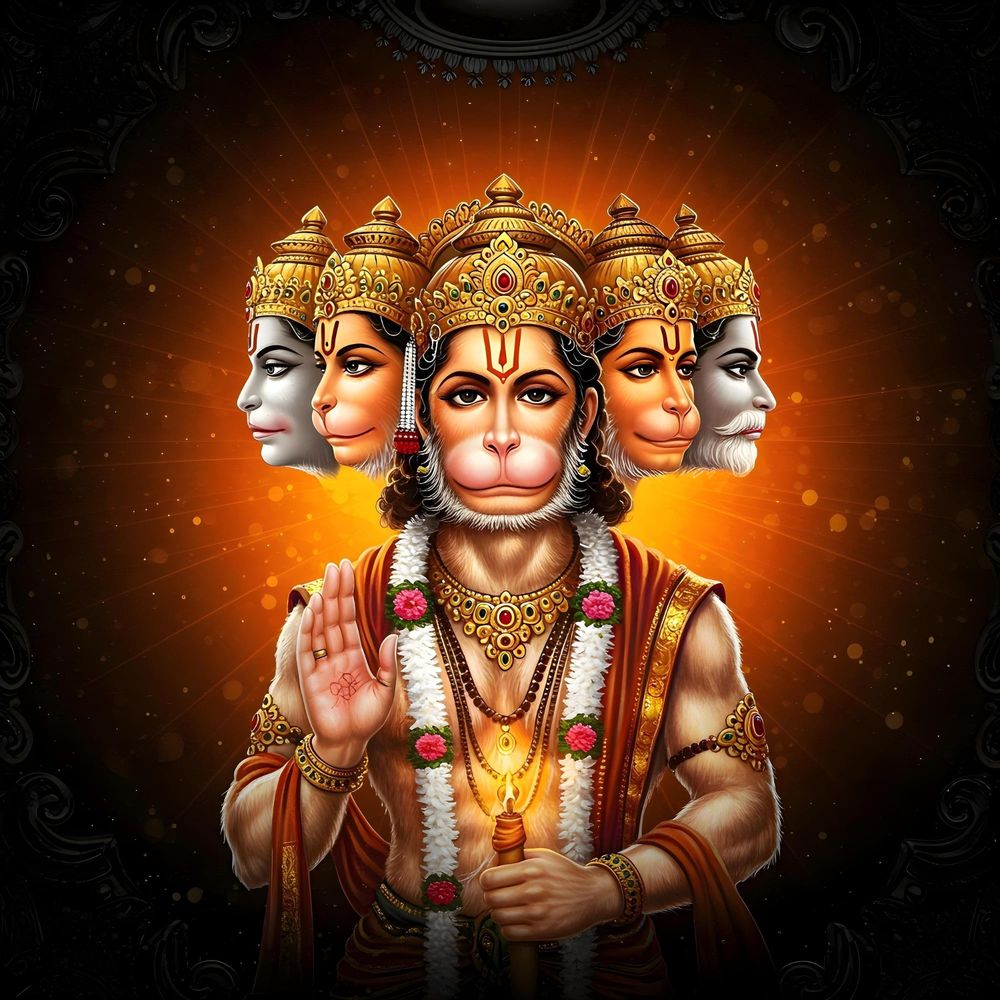
Panchmukhi Hanuman (पंचमुखी हनुमान) is the five faced form of Hanuman ji. The five faces (पाँच मुख) are Hanuman, Narasimha, Garuda, Varaha and Hayagriva, and he took this roop to save Ram ji and Lakshman ji from Ahiravan (अहिरावण) in Patal lok. मान्यता है कि इस रूप की उपासना से भय, शत्रु और नकारात्मक शक्तियों से रक्षा होती है. Here is what each face means, its direction, and how devotees remember this powerful protecting form.
What is Panchmukhi Hanuman
Panchmukhi Hanuman is Hanuman ji with five faces, panch mukh. Each face is a different divine form, and together they face all directions, so nothing can come at the devotee from any side. This is the roop people turn to for raksha, for protection from fear, negativity and every kind of trouble. It is the same Bajrang Bali we love, only in his fierce guarding form.
The story behind the five faces
The story comes from the yudh kand of the Ramayan. Ahiravan, a rakshas of Patal lok, carried Ram ji and Lakshman ji away by maya and kept five diyas burning in five different directions. He could only be killed, and the two brothers freed, if all five lamps were put out at the very same moment. So Hanuman ji took five faces, and with them blew out all five lamps together, killed Ahiravan, and brought Ram ji and Lakshman ji back. From that leela we get the Panchmukhi roop.
The five faces and what each one gives
Each face looks in one direction and removes one kind of trouble:
The tantric form, in plain words
Many searches ask about the tantric version of Hanuman. That is this Panchmukhi form. It is used in raksha upasana, worship for protection, and the Hanuman Kavach is its main paath. But I want to keep this simple and honest. For an ordinary bhakt like me, the Panchmukhi form is just a very powerful roop of Bajrang Bali to remember when the heart feels afraid. You do not need any special tantra or secret vidhi. Read the Kavach or the Chalisa before his picture with a clean heart, that is enough.
How devotees remember this form
People keep a Panchmukhi Hanuman photo or murti in the home mandir, light a diya or agarbatti, and read the Chalisa, the Bajrang Baan, or the Hanuman Kavach before it. Tuesday and Saturday are the special days. As with every paath, the protection it gives is real in this sense, it steadies the mind and takes away fear, so you can face things with courage. To read the protective paath of this form, see the Hanuman Kavach.
Frequently asked questions
What are the 5 forms of Hanuman?
Panchmukhi Hanuman has five faces, each a different form. They are Hanuman (the vanara face, east), Narasimha (south), Garuda (west), Varaha (north) and Hayagriva (facing up). Each face stands for a kind of protection, from enemies, fear, poison, and for wealth and knowledge.
What is the tantric version of Hanuman?
People mean the Panchmukhi (five faced) form when they say this. It is the form invoked for raksha, for protection from fear, negativity and bad influence, and the Hanuman Kavach belongs to it. It is still Bajrang Bali, just his fierce protecting roop. For a normal devotee it is simply a very powerful form to remember, no special tantra is needed.
Why did Hanuman take five faces?
In the Ramayan, during the war, Ahiravan took Ram ji and Lakshman ji to Patal lok and kept five lamps burning in five directions. Only by blowing out all five at once could they be freed. So Hanuman ji took five faces to blow out all five lamps together and rescue them. That is the story behind the Panchmukhi roop.
Which direction does each face point?
By tradition, the Hanuman (vanara) face looks east, Narasimha faces south, Garuda faces west, Varaha faces north, and Hayagriva faces upward. This is also the order in which the Hanuman Kavach salutes them.
Can I keep a Panchmukhi Hanuman photo at home?
Yes, many devotees keep a Panchmukhi Hanuman picture or murti in the mandir at home for protection. Keep it clean, light a diya or agarbatti, and read the Chalisa or the Hanuman Kavach before it. Shraddha is what matters, not any complicated rule.
Panchmukhi Hanuman ke 5 mukh kaun kaun se hain?
Paanch mukh hain, Hanuman (vanar mukh, poorv), Narasimha (dakshin), Garuda (paschim), Varaha (uttar) aur Hayagriva (upar ki or). Har mukh ek roop hai aur ek tarah ki raksha deta hai, shatru se, bhay se, vish se, aur dhan aur gyan ke liye. Yahi paanch milkar Panchmukhi Hanuman kehlate hain.
पंचमुखी हनुमान की पूजा कैसे करें?
मंगलवार या शनिवार को प्रातः स्नान करके पंचमुखी हनुमान जी की फोटो या मूर्ति के सामने बैठिए, दीपक या अगरबत्ती जलाइए, सिन्दूर और लाल फूल अर्पित कीजिए, और श्रद्धा से हनुमान चालीसा, बजरंग बाण या पंचमुखी हनुमान कवच का पाठ कीजिए. कोई कठिन तंत्र-विधि ज़रूरी नहीं है, साफ़ मन और भक्ति भाव ही सबसे बड़ी पूजा है.
One small thing about me. I am not a pandit or a big scholar, just an ordinary bhakt of Bajrang Bali from Jaipur. I made this page as seva, and I have checked the text with care. Still, if you notice any mistake anywhere, please write to me on the contact page and I will correct it.
Saurabh Satyaram, Jaipur