हिंदी · Hindi
बाल समय रबि भक्षि लियो तब तीनहुँ लोक भयो अँधियारो।
ताहि सों त्रास भयो जग को यह संकट काहु सों जात न टारो॥
देवन आनि करी बिनती तब छाँड़ि दियो रबि कष्ट निवारो।
को नहिं जानत है जगमें कपि संकटमोचन नाम तिहारो॥
Sankat Mochan · संकटमोचन
॥ संकटमोचन हनुमान अष्टक ॥
Namaskar 🙏 I am Saurabh, a devotee of Bajrang Bali from Jaipur. Whenever life becomes heavy, I sit quietly and read this Hanuman Ashtak of Tulsidas ji, and slowly the mind settles down again.
So I made this site. The full paath in Hindi, the same words in Hinglish and English, the story behind every verse, an audio to chant along, and a PDF you can print and keep. मान्यता है कि सच्चे मन से इसका पाठ करने पर हर संकट दूर होता है.

Here is how the Ashtak begins, in Hindi, in Hinglish and in English. The last line comes back after every verse, and that line is the heart of the whole paath.
हिंदी · Hindi
बाल समय रबि भक्षि लियो तब तीनहुँ लोक भयो अँधियारो।
ताहि सों त्रास भयो जग को यह संकट काहु सों जात न टारो॥
देवन आनि करी बिनती तब छाँड़ि दियो रबि कष्ट निवारो।
को नहिं जानत है जगमें कपि संकटमोचन नाम तिहारो॥
Hinglish · Roman
Bāl samay rabi bhakṣi liyo tab, tīnahuṁ lok bhayo aṁdhiyāro.
Tāhi soṁ trās bhayo jag ko, yah sankaṭ kāhu soṁ jāt na ṭāro.
Devan āni karī bintī tab, chhāṁḍi diyo rabi kaṣṭ nivāro.
Ko nahiṁ jānat hai jagmeṁ kapi, Sankaṭmochan nām tihāro.
English · Meaning
As a child you mistook the blazing sun for a fruit and swallowed it, and all three worlds fell into darkness. Creation was gripped by terror and none could undo the calamity. Only when the gods came and prayed did you release the sun and end the crisis. Who in this world does not know, O Hanuman, that your very name is Sankat-mochan, the remover of every trouble?
The famous Hariharan version, from the official T-Series Bhakti Sagar channel. Keep the lyrics open and say it along with him.
Press play and read the verses along with it.
Every verse of the Ashtak remembers one time Hanuman ji took away a big sankat in the Ramayan. Once you know the story, the paath feels very different.
| Verse | Starts with | The sankat Hanuman ji removed | Who was saved |
|---|---|---|---|
| 1 | बाल समय रबि भक्षि लियो | As a child, Hanuman ji swallows the sun and the three worlds go dark. The gods pray, and he lets it go. | The whole world |
| 2 | बालि की त्रास कपीस बसै गिरि | Sugriva hides on the mountain in fear of Bali. Hanuman ji goes as a brahmin and brings Ram ji to him. | Sugriva |
| 3 | अंगद के सँग लेन गये सिय | The search party with Angad sits tired at the sea, with no news of Sita ji. Hanuman ji brings the news. | Angad and the vanara sena |
| 4 | रावन त्रास दई सिय को सब | In Ashok Vatika, Sita ji is ready to give up. Hanuman ji drops Ram ji's ring before her. | Sita ji |
| 5 | बान लग्यो उर लछिमन के | Lakshman ji is struck by Meghnad's arrow. Hanuman ji brings Sushen vaidya and the Dronagiri mountain with the sanjeevani. | Lakshman ji |
| 6 | रावन जुद्ध अजान कियो | Ram ji and the whole army are tied in the naag-paash. Hanuman ji brings Garuda, who cuts every bond. | Ram ji and the army |
| 7 | बंधु समेत जबै अहिरावन | Ahiravan takes Ram ji and Lakshman ji to Patal to sacrifice them. Hanuman ji destroys him and brings them back. | Ram ji and Lakshman ji |
| 8 | काज किये बड़ देवन के तुम | The bhakt asks: you did all this for the gods, so what sankat of mine can you not take away? | You and me |
The doha at the end, लाल देह लाली लसे, describes Hanuman ji's red form and closes the paath. For the full meaning of each verse, see the verse by verse meaning.
Free tool · मुफ़्त
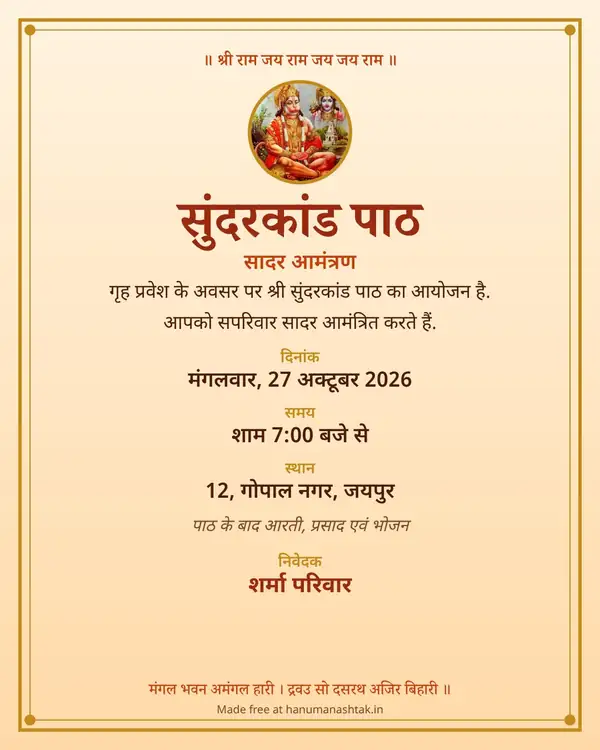
Holding a Sundarkand path at home? Make a neat card in a minute and send it straight on WhatsApp.
People often ask which one to read. They are not rivals, most homes read them one after another. Here is how they differ.
| Paath | Size | What it does | When | Time |
|---|---|---|---|---|
| Hanuman Chalisa | 40 chaupai, 3 doha | Praise of all his glories | Daily, morning or evening | About 8 to 10 min |
| Sankat Mochan Hanuman Ashtak | 8 verses, 1 doha | Remembers 8 times he removed a sankat, and asks for ours | Daily, right after the Chalisa | About 5 min |
| Bajrang Baan | Doha, chaupai, doha | An urgent call for protection | Tuesday, Saturday, or in fear | About 5 to 7 min |
| Hanuman Sathika | 60 verses | For a stuck matter or a long trouble | Tuesday | About 15 min |
| Hanuman Aarti | Aarti with refrain | To close the puja | At the end of any paath | About 3 min |
The Sankat Mochan Hanuman Ashtak is a short, very dear hymn to Hanuman ji. Where the Hanuman Chalisa sings his forty glories, the Ashtak does one thing, again and again. Each of its eight verses remembers a moment from the Ramayan when Hanuman ji stepped in and turned a hopeless situation around, and then it asks him to do the same for us also.
Tulsidas ji wrote it, the same mahatma who gave the Chalisa and the Ramcharitmanas. In most Hanuman mandirs the pandit reads this Sankatmochan Hanuman Ashtak just after the Chalisa. If you want to go deeper, see the verse by verse meaning, or the benefits and the right way to do the paath.
हनुमान अष्टक (संकटमोचन हनुमानाष्टक) आठ छोटी चौपाइयों में एक ही बात कहता है, कि हनुमान जी संकट मोचन हैं, हर संकट को हरने वाले. हर चौपाई के बाद यही पंक्ति लौटती है कि इस संसार में ऐसा कोई संकट नहीं जिसे हनुमान जी दूर न कर सकें. ईमानदारी से कहूँ तो इसका सबसे बड़ा लाभ यही है कि मन को साहस और शांति मिलती है, जिससे आप हर मुश्किल का सामना कम डर से कर पाते हैं. That settled courage is the real gift of this paath.
The Ashtak first, then the other paaths most of us read with it, and the questions people ask most.
It was written by Goswami Tulsidas (1532 to 1623), the same saint who gave us the Hanuman Chalisa and the Ramcharitmanas. The Ashtak is his, in the Awadhi bhasha.
There are eight verses. Ashtak itself means eight. After the eight verses comes one doha to close the paath.
Sankat means trouble and mochan means the one who removes it. So Sankat Mochan is Hanuman ji as the remover of every trouble. That same line comes back after every verse.
Any day is fine. Many people read it right after the Hanuman Chalisa. Tuesday and Saturday, and Hanuman Jayanti, are felt to be specially good.
Yes, there is no rule stopping anyone. Read it with a clean heart and shraddha, that is all it asks.
People hold it as a very powerful paath, because each verse remembers Hanuman ji actually removing some big trouble in the Ramayan, and then asks the same for us. Let me be honest about what that power means. It is not a magic that removes your effort or gives a guaranteed result. What it does give, and this is real, is courage and a settled mind, so a heavy sankat feels a little lighter and you can face it with less fear.
Because in eight short verses it holds one whole idea, that Hanuman ji is Sankat Mochan, the remover of every trouble. It is easy to remember, takes only a few minutes, and in most homes and mandirs it is read right after the Hanuman Chalisa. For someone who is worried or afraid, having these words by heart is a great support.
The whole Ashtak is about Hanuman ji and nothing else. Every verse recalls one of his leelas from the Ramayan, freeing others from danger, crossing the sea, bringing the sanjeevani, and after each one it returns to his name Sankat Mochan. So it is not just praise, it is a reminder of the times he has removed trouble, said back to him as a prayer.
There is no hidden name as such. The name the Ashtak keeps returning to is Sankat Mochan, the remover of sankat, and that is really the heart of it. The refrain after every verse says that in this whole world everyone knows Hanuman ji by that name. So the so called secret is out in the open, it is Sankat Mochan.
Bhakt ise sankat, bhay aur chinta ke samay padhte hain, kyunki iski har chaupai Hanuman ji ko sankat mochan ke roop mein yaad karti hai. Par sach yeh hai ki iska sabse bada fayda man ka shant aur nirbhay hona hai. Ise shraddha se roz padhiye, kisi jaadu ki tarah nahi, tabhi asli laabh milta hai.
प्रातः स्नान करके हनुमान जी की मूर्ति या चित्र के सामने बैठिए, चाहें तो दीपक जलाइए, और पूरे अष्टक की आठों चौपाइयाँ पूरे ध्यान से पढ़िए. अधिकतर घरों और मंदिरों में इसे हनुमान चालीसा के तुरंत बाद पढ़ा जाता है. मंगलवार और शनिवार विशेष दिन हैं. गिनती से ज़्यादा ज़रूरी है साफ़ मन और श्रद्धा भाव.
Yes, and that is the best way. Once a day, in the morning after a bath or in the evening after the diya, is how most people do it. It takes only about five minutes. There is no rule against reading it every day.
Yes. There is no time when Hanuman ji's name is not allowed. Many people read it before sleeping, especially when the mind is worried. Sit up, read it with dhyan, and then rest.
Both are good, and they do different things. The Ashtak is calm, it remembers eight times Hanuman ji removed a sankat and asks the same for us. The Bajrang Baan is an urgent pukar, read when there is fear or a heavy trouble. For daily paath the Ashtak after the Chalisa is enough. Add the Bajrang Baan on Tuesday and Saturday if you wish.
Yes. I have checked the eight verses and the doha here word for word against the Gita Press book Bhaktaraj Hanuman (book no. 185), pages 59 and 60. Some books and videos spell a few words a little differently, like भक्षि or भक्ष, तीनहुँ or तीनों. These are the same words written two ways, the paath is the same.
About four to five minutes if you read at a normal pace. The famous Hariharan version is a little over six minutes because of the music. With the Hanuman Chalisa before it, the whole paath is around fifteen minutes.
Yes, listening with a full heart is also bhakti. If you cannot read Hindi yet, play the audio or the official video on this page and follow the words. Slowly you will start saying it along, and that is the best.
सच कहूं तो इसके लिए कोई गुप्त विधि नहीं है. रोज़ एक तय समय पर, साफ मन से पाठ करना ही इसकी सिद्धि है. कुछ लोग 40 दिन का संकल्प लेकर रोज़ पाठ करते हैं, आप भी कर सकते हैं. पर किसी चमत्कार के पीछे मत भागिए, नियम और श्रद्धा ही असली साधना है.

One small thing about me. I am not a pandit or a big scholar, just an ordinary bhakt of Bajrang Bali from Jaipur. I made this page as seva and I check the text with care. The Hanuman Ashtak here matches the Gita Press book Bhaktaraj Hanuman word for word. Still, if you notice any mistake anywhere, please write to me on the contact page and I will correct it.Last checked and updated: 24 October 2026
Saurabh Satyaram, Jaipur
Paath reminders for Tuesday and Saturday, festival dates like Hanuman Jayanti, and every new PDF, shared first with our family on Telegram and Facebook. Free, and you can leave any time.